
Carvana is not the issue. The bigger question is, what comes next?
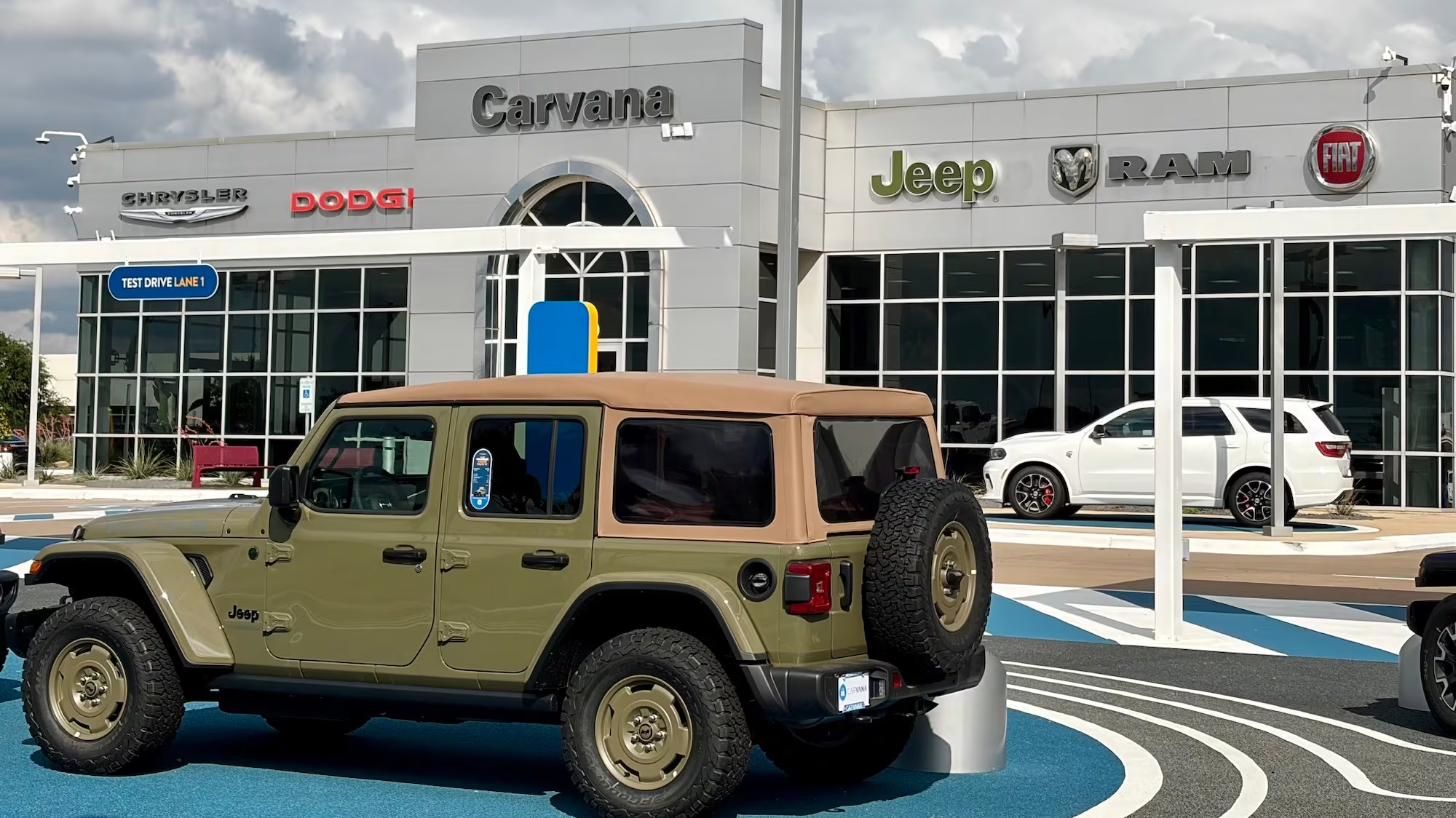
Carvana’s expansion into franchised new-vehicle dealerships is no longer a hypothetical trend. It is measurable, and it raises a question bigger than whether Carvana will keep succeeding: What happens to the franchised dealership system if this becomes the blueprint for the future of automotive retail?
In the second quarter of 2026 alone, Carvana retailed more than 197,000 vehicles and generated $7.4 billion in revenue, both company records, while its acquisition of franchised Stellantis dealerships has grown from a single Arizona store to seven locations across six states in 18 months.
A fundamental change in the competitive landscape
For more than a century, the American franchised dealership system has been built around locally and regionally owned businesses, many run by the same families for generations. They employ people in their communities, invest millions of dollars in automaker-required facilities and inventory, and represent manufacturers directly to consumers.
Today, those dealerships increasingly compete against organizations with fundamentally different economics. Carvana operates nationally, spreading technology, advertising, logistics and overhead across enormous volume in ways no five- or 20-store group can replicate.
Case in point: Carvana’s first Stellantis acquisition, a Chrysler-Dodge-Jeep-Ram store in Casa Grande, Ariz., previously sold 30 to 50 new vehicles a month as an independent franchise. Under Carvana’s ownership, it reportedly sold more than 700 in a single month in 2026, briefly the top-selling Stellantis store in the country.
The store didn’t change. What changed is who signs the dealership agreement — and, with that, access to Carvana’s national demand, financing and logistics infrastructure.
Why would an automaker encourage this?
The short-term appeal for manufacturers is real: A national retailer can move more inventory and create a consistent digital experience.
But automakers should ask a longer-term question: What happens if the strategy succeeds too well? Manufacturers have spent decades building thousands of independent businesses that invest their own capital, compete with one another, and create an enormous retail and service infrastructure without requiring manufacturers to own it.
Weakening that network in pursuit of short-term efficiency could concentrate market power among a handful of national retailers. The partner that helps a manufacturer gain share today may have the scale tomorrow to dictate terms.
The real risk isn’t online sales
The scale, by the numbers: Carvana has disclosed $200 million in cumulative purchase consideration for its seven franchised dealerships through its own SEC filings — $160 million for five acquired in 2025 and $40 million for two more in the first half of 2026 — backed by a $300 million floorplan credit line with Stellantis Financial Services.
The risk isn’t that consumers buy cars online; dealerships have already adapted to that. It’s concentration of economic power. If automotive retail consolidates into a handful of national platforms, we risk losing the defining strength of the franchise system: thousands of independent owners competing for customers and investing in their local markets.
The 16,990 franchised dealerships in the U.S. today have invested more than $200 billion in local land, buildings and infrastructure, and support 1.1 million jobs, most held by people living within driving distance of the store. That should matter to manufacturers, regulators and dealers alike.
How the family dealership competes
The answer can’t be “work harder”; most dealers already do. A 10-store dealership group can’t suddenly become a thousand-store company. But dealers can create many of the economic advantages of scale without surrendering ownership: aggregating purchasing and lender volume, negotiating collectively with vendors, sharing technology infrastructure, and eliminating intermediaries that extract economics from the dealer.
A 10-store group negotiating alone has one level of leverage. Five hundred dealerships negotiating collectively have another. That is how dealerships compete against organizations with dramatically greater scale: not by becoming Carvana, but by building collective scale while preserving independent ownership.
A decision point for the industry
Carvana isn’t the enemy. It is doing what successful companies are supposed to do: innovate, scale and challenge established models.
The responsibility now belongs to the rest of the industry. Automakers need to weigh the long-term consequences of concentrating retail power. Dealer associations need to examine whether franchise protections built for a geographically based system remain adequate in a world of national digital distribution. And dealers need to recognize that independence without scale is increasingly difficult to sustain.
The real question isn’t whether Carvana can compete with the traditional franchised dealer. It clearly can. It’s whether the traditional dealer will create a moat to compete with Carvana and whoever comes next. That may determine whether the next century of automotive retail remains a system of independent entrepreneurs or is controlled by a handful of national corporations.

See What Your Dealership BusinessCould Be Earning Back.
A personalized analysis can show you the numbers. Let's talk about your specific dealership.